
I seem to be writing about dungeon synth a lot these days and I’m not entirely sure why. Admittedly I have been buying a lot of it lately, but it’s not as if plenty of other genres aren’t making it onto the stereo at Life In The Vinyl Lane World HeadquartersTM. But for whatever reason the dungeon synth releases seem to put me in the writing headspace. Back on the earlier version of this blog I wrote about basically every single release I bought, unless I legit hated it. After a while that made the blog feel a bit like work, something I had to do, a compulsion. With LITVL 2.0 I promised myself I’d only write when I felt like it, and at the end of the day dungeon synth makes me want to flip open the laptop and begin typing.
Vond was a mid-90s project by Håvard Ellefsen, better known to the world by his nom-de-musique Mortiis. While there is some debate as to who is the true “father” of dungeon synth (more about that in another post HERE), no one in the community questions Mortiis’ bonafides as an early, seminal, and still-relevant figure in the genre. He’s a true OG and continues to tour today.
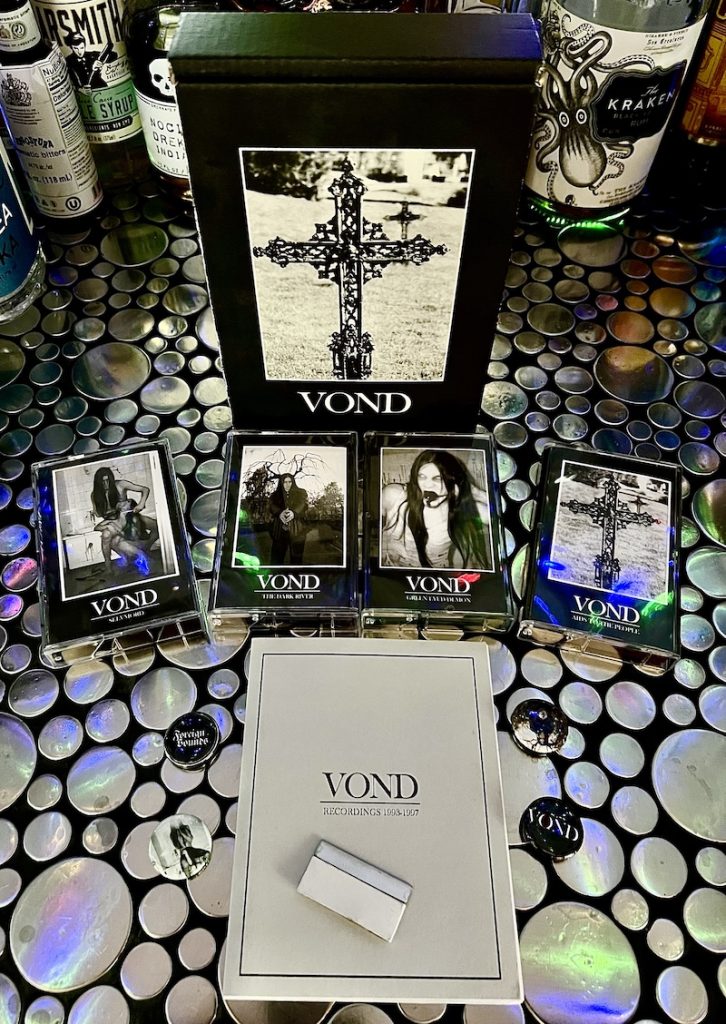
Vond is widely described as “the darker side of Mortiis”, which is interesting because most of his music is, generally speaking, “dark”. I’ve also seen it described as leaning more industrial – but more on that below as I listen to this collection. Recordings 1993-1997 is comprised, as near as I can tell, all of the Vond material – three full-length albums and a fourth that is more like an EP with three previously unreleased tracks and two songs that appeared on a 7″ back in 1993 It’s served up on four cassettes and packaged inside a printed cardboard box along with a small booklet, for buttons (or badges as my friends in the UK would say), and, what’s that in the corner? Oh, yeah, a razor blade (unused, thankfully). The collection is limited to 31 numbered copies so it won’t be the easiest thing in the world to find, though I got mine on Discogs so it does pop up from time-to-time.
Selvmord (originally released in 1994)
Organs and bells conjure up the sensations of a gloomy stone church, the kind of building that never gets any direct sunlight other than through a few small stained glass windows, ensuring it remains cool inside even on the hottest days, the air stale and musty after a few hundred years of poor airflow. As the A side progresses the music becomes richer, but remains submissively in minor keys, not exactly wallowing in its own sadness but more accepting its fate. There’s a flow to the sound, an underlying story of hope in the face of hardship, but a hope ultimately in vain… unless the act of hoping itself is the purpose, that latching onto something that helps you hang on.
The B side introduces urgency, startling orchestral-like percussion booming out of the speakers, calling forth images of armored men on horseback grimly riding forth through the gloom on their way to battle some unspeakable evil. Once those riders pass us by we’re back to church organs, now played with more confidence and boldness.
“Selvmord” translates to “suicide” in Mortiis’ native Norwegian, a fitting title given the melancholy of the music. Allegedly the album was banned in some locations upon initial release due to the black-and-white cover image depicting a nude man holding a knife to the throat of a crouching nude woman in a blood-splattered bathroom. The original vinyl release included a poster with a second image of this same scene. Certainly the intent is to shock the viewer, which it absolutely would have done in 1994. Thirty-plus years later it feels a bit performative and unnecessary. But art exists to generate an emotional response, and in that respect these images succeed.
The Dark River (originally released in 1996)
The opening pattern of the first track, “Love I Never Had”, has a sci-fi flavor to it, something from a dystopian near-future in which the technology has advanced but the social order is fraying around the edges. There’s a very strong soundtrack vibe here – you can close your eyes and imagine an entire movie playing as the mood ebbs and flows. One could argue the futurism is actually retro-futurism, harkening back to the late 1970s/early 1980s synths of Tangerine Dream, Eno, or Giorgio Moroder. “Høst II” is more insistent, the pacing more deliberate and less smooth, a purposeful, determined walk with a steady stride. “Suicide Is Painless” takes us an entirely different direction, underground into the sewers where the dripping of the water and sound of our wet footsteps echos claustrophobically as we apprehensively try to peer through the dank surroundings. The B side is also a stylistic mix, making The Dark River feel like more of a collection of songs than a cohesive concept – though not in a bad way, because every track is enjoyable.
Green Eyed Demon (originally released in 1998)
Green Eyed Demon opens with a low drone, a current of mumbled speaking running underneath before the introduction of the narration from some kind of 1960s-era film about the prison execution process, a creepy walk down the hallway and into the death chamber where we’re strapped into the electric chair… Is it social commentary or simply horror? Probably both. This style continues through the rest of the A side on “Living Among the Remains of Dead People” and “Satan At My Back”, the primary change between songs being the narrator. It’s intriguing, something you know you should find troubling but simply can’t turn away from. This carries through on the B side, though the underlying music is less drone and more doom-ish. Probably my favorite of the Vond albums.
AIDS To The People (originally released in 2017)
The A side consists of three tracks originally recorded in 1995 and intended for a 10″ but never released, while the B side is comprised of the two songs on the 1993 7″ “Alene I Stillhet” / “Forlatt”. All five tracks, especially the two on the B side, have a dungeon synth feel, with only “Doomed To Solitude” as a partial outlier.
You can find all the Vond releases on the Mortiis Bandcamp page HERE. The Dark River and Green Eyed Demon are also available for streaming on Spotify, but note its Vond page also includes some releases from the 2000s that, after listening to them, I’m 100% confident are NOT in fact by this Vond, but by some other Vond (or a Vond-poster).