
(For more on Jim Kirkwood you can read about his Middle Earth Trilogy HERE and his Sandman Trilogy HERE)
Dungeon synth is going through growing pains right now. It reached a point where at least one Facebook group has 12,000+ members and #dungeonsynth has been used over 139,000 times on Instagram. Those are paltry numbers even compared to other non-mainstream genres (#blackmetalmusic has been used 280,000 times on Instagram), but still surprisingly robust for such a niche category of music.
With that growth comes some hand-wringing and gatekeeping, but my perception is people exploring dungeon synth are attracted to what is at times alternately described as the “low bar to entry” and “amateurishness”. Yes, there are some very talented musicians in the space. But there are also many, many others (like me) who were inspired by it, bought a cheap MIDI, and made music themselves for the first time. And that, to me, is worthy of a certain amount of celebration.
Over the last year or so it appears dungeon synth has reached critical mass and is here to stay,and as a result people are investigating its roots, to the point were there are not one, not two, but three books are now available on the genre. Two of these are rather short – the 72-page 101 Dungeon Synth Albums You Must Hear… Before You Rot In a Dungeon by S., and Ruslan Akimov’s 118-page Dungeon Synth: The Rebirth of the Legend. The third is a tome big enough to cause your back to go out if you don’t bend at the knees when picking it up, Jordan Whiteman’s recently-released 346-page glossy-paged hardback Dark Dungeon Music: The Unlikely Story of Dungeon Synth. There are also an ever-increasing number of blogs and video pods devoted to the music and its history.
One of the big questions any new-ish genre tries to define is its origin story. Logically this is an impossibility – has there every truly been a time when a new subgenre sprung forth completely free of any earlier influences, like the goddess Athena emerging fully formed from Zeus’ head? I suspect not. The further back you go and the more threads you pull, the more connections you’ll find and the less clarity you’ll achieve. But it’s human nature – we want, no need, an origin story. And so it is with dungeon synth. And one of the candidates as its progenitor is a gentleman named Jim Kirkwood.
Kirkwood played in various rock and metal bands in the 80s before picking up the synth, becoming quite prolific with it. His albums from the early 90s are considered, by some, to be the ground zero of dungeon synth. In 101 Dungeon Synth Albums You Must Hear…, S. lists the albums by year, and the very first entry is for Kirkwood’s 1990 tape King of the Golden Hall. He does, however, confess to his own doubts, writing “… I hesitated for so long whether it should be here, that is whether it can really be labeled as dungeon synth or not.” Eventually S. concluded that it does in fact belong in the pantheon. Others, however, are not convinced. Akimov doesn’t even mention Kirkwood in his book (which, to be fair, is primarily comprised of artist interviews) as near as I can tell. As for Whiteman, he has a very strong opinion on the subject, so much so that his chapter on the origins of dungeon synth includes a section literally titled, “The Problem With Jim Kirkwood”. He ultimately concludes: “However, Jim Kirkwood’s earlier work cannot be categorized as a dungeon synth; it is more reminiscent of some tangentially related post-industrial or electronic subgenre.”
What we can say definitively, however, is that dungeon synth fans are interested in Kirkwood’s 1990s output. How do we know? Well, these originally self-published tapes are getting re-released in some pretty impressive quantities. Last year three of his earlier albums (which I wrote about HERE) were re-issued by Out of Season, each in an edition of 300 cassettes and 300 CDs, which are now sold out. Following up on that success Out of Season just put out the three albums of Kirkwood’s 1991 “The Eternal Champion Trilogy”, with Tales From a Melnibone Tavern and Souls That Dance on the Edge of a Sword coming out in pressings of 300 cassettes, 300 CDs, and 500 copies on vinyl, and Master of Dragons an impressive 500 tapes, 500 CDs, and 1,000 records. Clearly there is demand, and that demand is coming from the dungeon synth community.
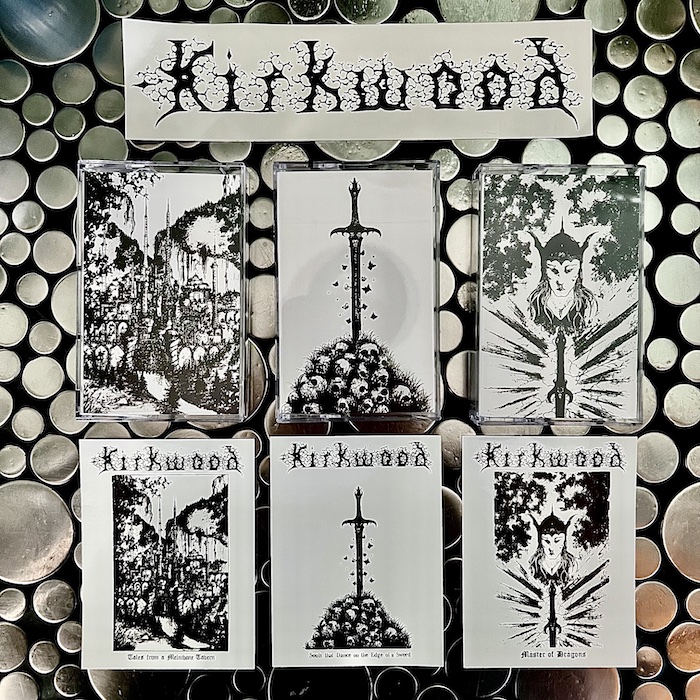
So what of these three albums? Kirkwood drew inspiration from Michael Moorcock’s Melnibonéan mythos and concept of the eternal champion. Do the albums qualify as early dungeon synth? I guess that depends. Tales From a Melnibone Tavern certainly contains elements, most notably on the heavily atmospheric “Emerging Chaos” which, while lacking a sense of medieval-ness that permeates so much of the genre’s sound today, creates an environment of existential dread so prevalent in early black-metal-influenced dark ambient. The first half of the 20-minute “Gypsy Nation” leans into the fantasy realm, though the second half wanders into more Berlin School and Tangerine Dream territory, as does the closing track “Riding the Dragon”. Souls That Dance on the Edge of a Sword moves even more into the spacey synths than ended the prior album, still setting itself firmly into the world of fantasy but doing so in a more out-of-time kind of way. It’s more reminiscent of a film score to a post-apocalyptic film, one in which the sword-wielding hero must fight mutants in the wasteland to complete his quest, a heavy straight-to-video kind of vibe. As for Master of Dragons, it’s arguably the most thematically cohesive of the three. The feel is more Logan’s Run than Lord of the Rings, which is not a bad thing. I for one am OK with some sci-fi in my dungeon synth, and Master of Dragons offers us a triumphant conclusion to the trilogy… at least until the final track, “Land of Madness”, which begs the question, will the eternal champion finally get his much deserved rest, or will he simply repeat the cycle yet once again?
Where do I stand on the “is Jim Kirkwood dungeon synth” debate? I’m not sure it matters, really. I agree with S. that King of the Golden Hall definitely has a dungeon synth feel to it, beyond just the cover imagery and the inspirational sources – it’s easy to close your eyes and be transported to a medieval-like realm. As for the three albums in this trilogy, their sonic qualities put them into a broader fantasy sphere, one that could just as easily include sci-fi. At the end of the day, it seems more like an interesting thing to talk about over a few beers than it is something meaningful. Just enjoy the music for what it is.
All three albums comprising “The Eternal Champion Trilogy” are still available from Out of Season HERE.