
On February 28, 2026 the United States and Israel launched their joint attack on Iran. I’m not sure what this war will be called in the future, or how long it will last given that victory was already declared but the bombings recently resumed. Regardless, on the same day the explosions started a strange radio broadcast was heard on the 7910 kHz shortwave frequency. The voice on the radio opened by saying Tavajoh! before beginning to read of numbers in Farsi (“tavajoh” translates to “attention”). The next day the speaker moved down the dial a little to 7842 kHZ, where they continued to broadcast twice per day at 02.00 UTC and again at 18.00 UTC, some sessions lasting as long as two hours, reading number after number after number.
It didn’t take experts long to recognize this for what it was. The birth of a new numbers station. But there was also an important question to be answered. Who was operating it?
The concept of a numbers station is very easy to understand, and its relative simplicity and near-total security (when correct procedures are followed) is why even today, with all our high-speed digital technology, numbers stations are still in use. There are two parties involved – the sender of the message, and the receiver. The sender uses a powerful shortwave transmitter, because shortwave radio signals can be bounced of the earth’s ionosphere, allowing them to reach great distances, well beyond what could be reached by line-of-sight from the sending location. The receiver needs a small shortwave radio, the kind of thing that’s pretty widely accessible and unlikely to attract attention from anyone who doesn’t know precisely what they’re looking at. Oh, and the also need a one-time pad.
In essence a one-time pad is a key that allows letters to be converted into numbers and back to letters. If the receiver knows which key was used to encrypt the message, and they have the one-time pad associated with that key, they can they decrypt the numeric code and reveal the message. The reality is somewhat more complicated – it’s not simply saying “M equals 12” and sending that – an encryption that simple would be child’s play to a professional cryptanalyst and laughable when faced with modern digital tools. There are two requirements – the key itself must be generated using truly random number generation (more on that later), and the key is only used one time (hence “one-time pad”). If both those elements are in place a message coded with a one-time pad is “information-theoretically secure”, a formal term meaning that someone with unlimited computing resources and time still cannot decrypt the message. In other words, it’s unbreakable.
In the modern era with its supercomputers and exponentially evolving Skynet-like AI the idea of a truly unbreakable code seems absurd. But it’s true. One of the problems, however, is that random number generation is actually quite difficult to achieve. To get there you can’t simply go into Excel and type “=RAND()”. Sure, that’ll work for most purposes (when I was an insurance data analyst I’d sometimes use random number generation as a way to randomly pull rows of data for review, or to select random groups of policies for a pilot program). But it turns out most processes, like Excel, in fact create pseudorandom numbers, sets of numbers that appear random, but at their root is an underlying algorithm which, if known, can be used to predict the next number in the sequence… and the next… and the next. True random number generation is possible, but the process is much slower.1
So what of our new Farsi-language numbers station? There was initial speculation that Iran was behind it. This would make sense given the reading was done in Farsi, and it’s very reasonable to expect that Iran would have intelligence agents in various parts of the world equipped with one-time pads who had been instructed to listen to a certain shortwave frequency in the event of an attack on the country. But that story started to unravel quickly when experts revealed that someone was using a technique called “bubble jamming” to attempt to block or disrupt the shortwave signal. And who regularly uses bubble jamming? Iran, to block broadcasts such as Voice of America from reaching its people. In the days that followed intrepid researchers used triangulation to more-or-less solve the mystery – the broadcasts appear to originate from a US military base in Böblingen, Germany, which unsurprisingly is known to have a shortwave broadcasting facility. So arguably the most technologically advanced military and intelligence apparatus in the world is using shortwave radio and one-time pads to communicate with agents located, in all likelihood, inside of Iran. More on this numbers station can be found HERE.
What does all this have to do with a blog called Life in the Vinyl Lane? Well, that’s where The Conet Project comes into play.
Irdial Discs is an independent UK-based label owned by Akin O. Fernandez. Fernandez runs the label under what he calls the Free Music Philosophy. According to the label’s website, “It is an anarchistic grass-roots, but high-tech, system of spreading music: the idea that creating, copying, and distributing music must be as unrestricted as breathing air, swimming in the sea, or basking in the rays of the sun.” This does not mean, of course, an artists’ music can be copied and used for commercial purposes without their permission. “Specifically, Free Music means that any individual has the freedom of copying, distributing, and modifying music for personal, noncommercial purposes. Free Music does not mean that record labels and musicians cannot charge for records, tapes, CDs, or files.” Make the music widely available. Allow people to make their own copies for their own use. But don’t turn around and use someone else’s music to make a buck without their permission. This will become important as our story progresses.
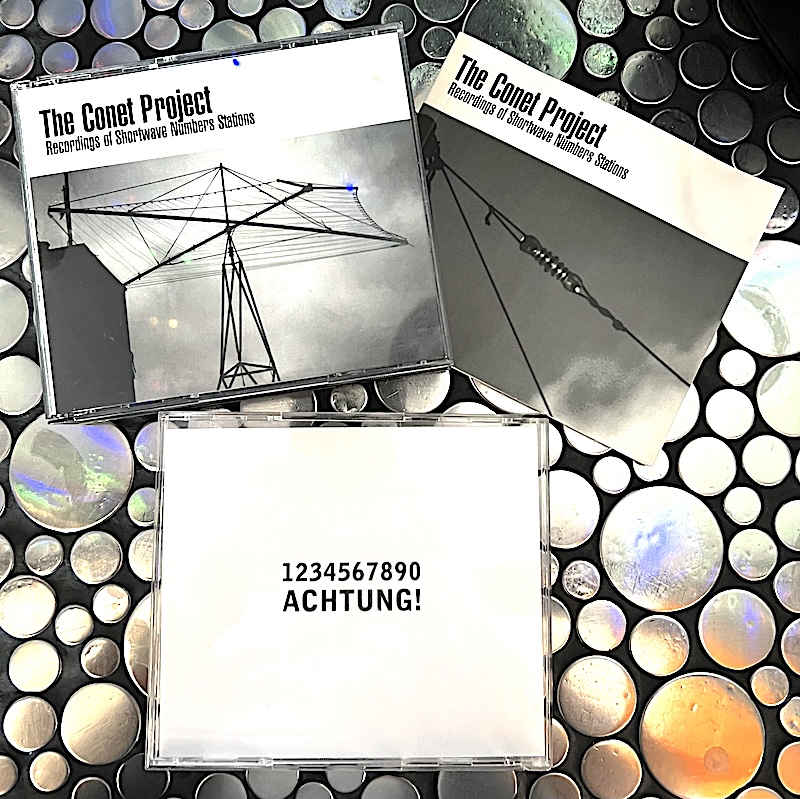
Fernandez was fascinated by numbers stations and kept a journal to record where and when he found them across the shortwave band. He also started recording them, and connecting with like-minded obsessives who did the same, some of who shared their recordings. And thus The Conet Project was birthed into the world in 1997, a 4-CD, 150 track collection of numbers station audio (also included is a 74-page booklet). Brief musical or tonal signals announcing that a message is forthcoming. Spectral voices saying phrases and reading numbers… men and women speaking in English and German and Chinese and Russian and Spanish… dashes and dots… sound waves.
The first time I played Recordings of Shortwave Numbers Stations my heart truly skipped a beat. This was listening to something truly forbidden. Something you’re not supposed to hear. It’s spycraft happening out in the open, or at least open enough if you know where to look, the curtain being pulled back on something not intended for your ears. The scratchy voices are haunting. Something so basic, a person reading numbers, shouldn’t generate this kind of visceral response, but it does to me. I have a friend who likes to put on Recordings of Shortwave Numbers Stations as a background when he needs to concentrate on something. I could never do that. To me it’s almost disturbing in a way, something hyper-real. It’s like sneaking into your parents’ liquor cabinet for the first time, or the first time you saw drugs. Illicit. Dangerous. Forbidden. Transgressive.
According to UK law, however, it’s actually illegal to listen to numbers stations. Not to record them specifically, but simply to listen, as one reporter found out when they reached out to the British Department of Trade and Industry (DTI) to ask about reports from regular citizens about numbers stations. “These people shouldn’t have any interest in numbers stations because they shouldn’t be listening to them,” said the DTI representative, “because they are illegal to listen to.” Per section 48 of the Wireless Telegraphy Act of 2006:
(1) A person commits an offence if, [F1without lawful authority] —
(a) he uses wireless telegraphy apparatus with intent to obtain information as to the contents, sender or addressee of a message (whether sent by means of wireless telegraphy or not) of which neither he nor a person on whose behalf he is acting is an intended recipient, or
(b) he discloses information as to the contents, sender or addressee of such a message.
The punishment? “A person who commits an offence under this section is liable on summary conviction to a fine not exceeding level 5 on the standard scale.” And according to what I can find online, “Level 5 is typically reserved for the most serious summary offenses—such as corporate regulatory breaches, major environmental violations, or high-level health and safety failures” and… there is no maximum to the fine amount. So just listening to something that isn’t intended for you, even though it’s being broadcast out into the world and available for anyone with fairly basic equipment to hear, is illegal with no cap on the monetary penalty. Which is pretty wild.
In 2002 the band Wilco sampled some audio from Recordings of Shortwave Numbers Stations and even used some of the words from one of its recorded broadcasts to name their album, Yankee Hotel Foxtrot. You may wonder how Fernandez felt about this given his Free Music Philosophy. Well, let’s not forget the part about “noncommercial purposes”. And Wilco didn’t even bother to ask for permission.2 So Fernandez sued.
There were some interesting legal questions raised. Can someone claim ownership over something that anyone could have recorded? It turns out, under UK law the answer is yes, the act of recording does confer some rights to that specific recording. There was also a question about if the specific sample in question was one recorded by Fernandez or one he obtained from someone else, but that too was resolved. Wilco settled out of court in 2004, paying roughly $30,000 to cover Fernandez’s legal fees and granting him undisclosed royalties, royalties that allowed him to re-launch Indrial, which had been shuttered a few years earlier. It also allowed him to re-release Recordings of Shortwave Numbers Stations later that year, and again, this time with a fifth CD, in 2013.
Irdial is down to the last two remaining copies of the 2013 edition on it’s website, with a current price of $5,000 for the next one to sell and $10,000 for the last copy when that time comes.3 But have no fear – the most recent sale of this version on Discogs was around $300 – so that’s probably a better bet, and the earlier 4xCD versions can be found in the $150 range. Still not cheap, but Recordings of Shortwave Numbers Stations is a truly unique collection and listening experience. And staying true to the Free-Music Philosophy, you can listen to recordings on The Conet Project’s Soundcloud page HERE free of charge.
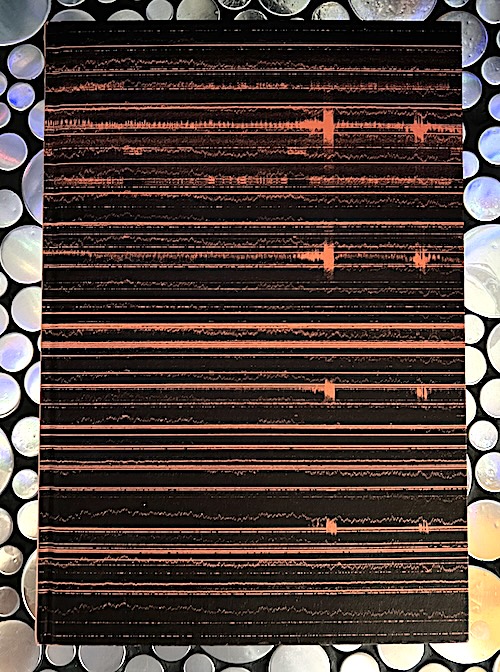
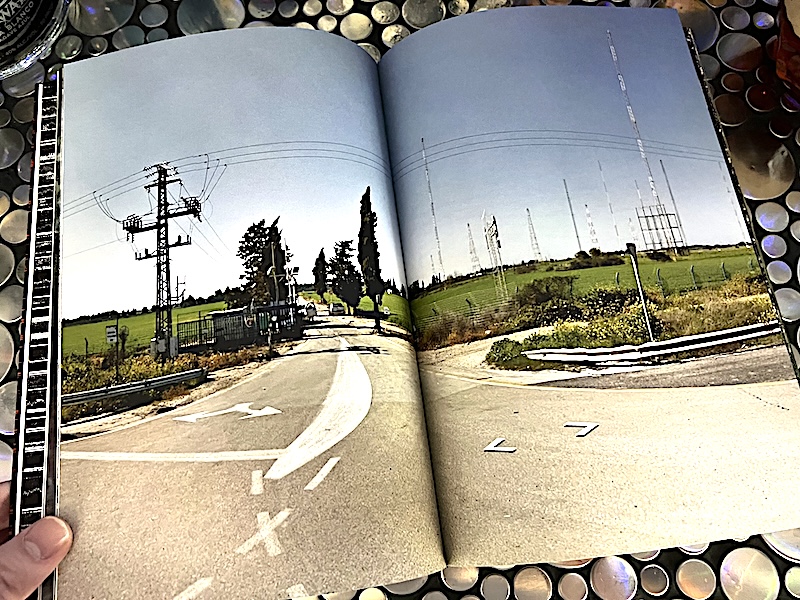
Lewis Bush is a senior lecturer in documentary photography at London College of Communication, University of the Arts London. He describes his work as follows: “I research, write and make images to explain disparate forms of contemporary power and the links that connect them.” I first learned of Lewis via his 2018 book, Shadows of the State, which leverages geolocations of suspected numbers stations to find publicly available satellite images of the area, images he studies to identify the likely source of the transmitter. Shadows presents a collection of these images along with information on each, including what we know of their broadcast history. It’s a fascinating and important book and I was thrilled when Lewis agreed to answer a few questions.
Lewis, you describe your work as seeking “ways to make forms of contemporary power visible, and more importantly legible.” Your work has examined the subversion of local democracy by developers, the rise of the offshore financial system, and the connections between the space race to colonialism and the Holocaust. Numbers stations are very much a niche within a niche (and possibly within a few more niches) of state power. How did you come to focus on these stations in Shadows of the State?
“That is true, but most of the things I am interested in talking about are far too big to tackle in their entirety and so the strategy I tend to employ in my projects is to look for a microcosm which seems in some interesting way to speak for the bigger topic. So numbers stations are an extremely small area of intelligence gathering as you say, but I felt they could open up interesting insights, particularly into the idea that spying is never really as far away from us as we think. That’s true in terms of the transmitter sites, many of which are in banal and familiar places, but it is also true of the signals, which are around us all the time, and one presumes to some degree also true of their anonymous recipients. In terms of how I came to focus on numbers stations specifically I think it was actually through a Wikipedia dive while I was avoiding working on something else that I first came to them, and from that page I began reading many of the more specialists sites maintained by hobbyists who monitor them. That was what really opened this world to me.”
Numbers stations, functioning as they do in the realm of covert communication, are bizarre for two obvious reasons. First, anyone with a shortwave radio can simply hear the messages, which are broadcast in the open. The second is something that Shadows of the State drove home, specifically there’s a certain mundacity to these broadcast facilities which comes through in your images. Sure, some stations are well-protected, but many are simply small buildings and unassuming towers that one could simply drive past and not give a second though. Not only are the messages themselves broadcast openly, but to some extent even the apparatus is exposed. What are your thoughts on this? Are there any other clandestine operations that are done so seemingly in the open?
“First of all, I should say, as I try to get across in the book, that it is difficult to be 100% certain that the sites I focus on are definitively the correct broadcast sites. Because of the nature of the research, there is almost always a degree of doubt (with one or two exceptions which have been positively identified by other people through on the ground visits). But yes as you say, the probable sites are a curious mixture of the obviously clandestine and highly secured, and others which are simply anonymous and easily overlooked. The profile of others has changed over time, for example some of the older ones were originally remote and later were engulfed by towns and cities. As to other operations, clearly a large part of intelligence gathering does take place in plain sight in various senses, for example coded messages embedded in public media like newspaper articles or encrypted into image on public photo sharing sites, or the use of diplomatic cover for intelligence officers.”
What do you imagine the future to be for numbers stations? In a way it’s surprising they still exist given the advances in communication and encryption technology, but at the end of the day there isn’t anything seemingly more secure than a properly used one-time pad, and the relative ease of tuning into these signals even across great distances makes it very accessible.
“Numbers stations are to some degree an endangered species, even before the end of the Cold War it seems new communications methods were emerging that offered potential improvements, and the advent of the internet adds a further layer to that. But at the same time many of the stations still broadcast, and occasionally new ones appear, most recently a Farsi station began broadcasting from a US military base in Germany during the early stages of the 2026 US-Iran conflict. They remain as you say, a very secure means of communication, with the benefit that you don’t need any specialized (and therefore suspicious) equipment in order to receive their broadcasts, and also in terms of setting one up the technical bar is quite low compared to some other options. This probably in part explains why some of the countries who remain enthusiastic users of them are ones with less resources, for example Cuba, and North Korea.”
What are you currently working on?
“A few different things. I have just wrapped up an eight year project about the offshore financial system, again a vast area which I explored by looking in depth at just one jurisdiction, the Bailiwick of Jersey in the English channel. I was interested in exploring the ways that the offshore system is actually highly integrated with the onshore system, in contrast to the usual view of the latter as regulated and legitimate, and the former as lawless and criminal. I have just finished a 700 page book based on that which I need to think about looking for a publisher for. I have a few new projects I am slowly ramping up work on, but which I’m not really ready to talk about yet, and in the meantime I’m also finishing off my PhD research which looks at visual journalism and in particular the role of trust in it.”
Shadows of the State is essential reading if you’re interested in learning more about numbers stations, and Lewis had copies available for sale HERE. He also released a flexidisc in partnership with musician and producer Graham Massey that utilizes recordings of numbers stations.
ENIGMA 2000 is a UK-based group of number-station-philes, and one of it’s self-appointed tasks is maintaining and updating the ENIGMA Control List, which documents and codifies the stations (the most recently added was V32, the new Farsi-langauge station mentioned earlier). The identifiers for the stations aren’t that interesting – E03, G02, S32. But many of these stations also earn their own nicknames which are generally associated in some way with their broadcasts – the music or sound preceding the numbers list, the type of person speaking (interestingly the person reading the numbers is often female), or some other attribute. The three stations I listed are better known as The Lincolnshire Poacher, The Swedish Rhapsody, and The Squeaky Wheel. ENIGMA 2000 is your online numbers station rabbit hole and publishes an online newsletter multiple times per year, the most recent of which is issue #155. You can lose hours there. Trust me. If you want to learn more about numbers station, that’s the place to go.
I encourage you to give Recordings of Shortwave Numbers Stations a listen. It’s a important collection of audio – politically, socially, sonically, and yes, artistically. Come on down into the rabbit hole…
Sources:
Conet Project homepage HERE
Listen to tracks from Recordings of Shortwave Numbers Stations on The Conet Project’s Soundcloud HERE
On YouTube! HERE
ENIGMA 2000 – everything numbers stations HERE
Washington Post article on the Wilco suit HERE
Wired article HERE
UK Wireless Telegraphy Act 2006, Section 48 HERE
- An interesting example of this can be found in things like the “random” feature on something like a Spotify playlist. We as users thing we want truly random, but when faced with true randomness things will happen by chance that will annoy us. For example if you have a playlist of 100 songs and they are being played truly randomly, then roughly one out of every one hundred songs played will… be followed immediately by the same song. It also might reappear two, or three songs later. We think we want random, but what we want is pseudorandom – we don’t want Spotify to always play the songs in the same order, but we also don’t want the same song to repeat too close in time to the last time it was played. For most practical purposes this is fine. But when it comes to spycraft it could get your messages decrypted by exactly the kind of people you’re trying to hide them from.
↩︎ - Fernandez let Cameron Crowe use some number stations audio in his film Vanilla Sky, free of charge. Why? Because he asked nicely.
↩︎ - When Irdial was down to its final 20 copies of Recordings of Shortwave Numbers Stations, the offered them for sale on a sliding scale. The first 12 of the copies to sell were $100 each. Each remaining copy went for a higher price. The seventh copy left sold for $156. The sixth for $312. Then it was $625, $1,250, and $2,500, until only two copies remain. If you want one, that’ll set you back $5,000. The last copy will be a whopping $10K. ↩︎