
I know there are a lot of people who don’t like blogs or reviews that contain a heavy dose of the writer’s personal experience. I get it – sometimes you just want the information. But Life In The Vinyl Lane is as much about my relationship to music as it is about the music itself. I’m sure I could mostly separate the two things if I tried, but at the end of the day one’s opinions about art are, at least in part, informed by personal preferences and experiences. So if you’re one of those “just the facts, ma’am” folks, you can skip the next few paragraphs and start reading after the picture when I’ll discuss the quality of this Japanese pressing of Shout At The Devil.
If you stuck around for this paragraph, welcome, and allow me to regale you with a musical memory that has been seared into my brain for over 40 years. In the summer of 1982, when I was 11, my family moved from Anchorage, Alaska, to Columbia, South Carolina. If you know anything at all about the United States you can probably imagine that this was a huge culture shock. And it was probably an even bigger one than you think, on practically every level possible. At this point in my life I’d already attended five different schools and lived in three different states, and now I was starting over again. To top it off, I’d be entering the 6th grade in a middle school, putting my small, un-athletic, new-to-town self at the bottom of the food chain. On the school bus someone called me a “yankee”. That’s what it was like in the south in 1982. Calling an 11-year-old who had just moved there from Alaska a “yankee”.
Anyway, my parents took the incredible step of having cable TV put into our house, not only in the living room, but also in my bedroom. I suspect it was in part to placate me after yet another move. And to some extent it worked. Now, we’d had cable in Alaska, but cable there was weird. There were only a couple of non-network channels, most notably TBS out of Atlanta (so at least I was already a Braves fan…) and HBO. The selection in Columbia included both of those and a host of others, most importantly a relatively newcomer to cable called MTV.
MTV became my radio station at a time I was just discovering music. It was on in my room constantly. The second I got home from school I went to my room and turned on MTV, and it likely stayed on until I went to bed at night, unless I was playing Atari or watching a movie on HBO that was most definitely inappropriate for my age. MTV at that time was amazing. Non-stop videos of almost every genre imaginable and it exposed me to a wide array of music. Videos were just starting to come into their own, and while lip sync-ing stage footage was still pretty common, ideas were starting to get… interesting, as were the looks, especially of the metal musicians.
While the single for Mötley Crüe’s “Looks That Kill” came out in January 1984, as near as I can tell the video came out in late 1983. And… it blew my mind. At that point Quiet Riot had gotten me interested in what we’d later come to call hair metal, but at the time was simply heavy metal, but the guys from Crüe took it to a whole different level. Right from the opening riff it was game on, scantily-clad women climbing out behind rubble in some kind of post-apocalyptic soundstage set that even in 1983 looked low budget. Then the band emerge wearing a crazy assortment of studded leather, football pads, fishnets, and enough hairspray to rip a hole in the ozone layer, locking up the women before picking up the instruments and performing. Then there’s a windstorm (why?) and a female warrior arrives, freeing the women and acting as a seductress trying to lure Vince Neal into a trap. After a few close calls she’s surrounded by the band members who raise their fists in the air, causing her to disappear in an explosion that just leaves behind a flaming pentagram on the ground. And that description is, I think, a bit understated when it comes to how insane the video is. Watching it again 43 years later is wild. And awesome.
But I digress. I of course had to have this album. I had an all all-in-one stereo in my room, but I’d also gotten a cassette walkman as a gift, so I figured given how dangerous Mötley Crüe seemed my safest bet to hide it from my parents was to buy a tape. My mom was hairdresser at a big shopping mall in town and sometimes during summer vacation I’d go into work with her and spend the day wandering the mall, playing video games at the arcade, and eating pizza by the slice. On one of those trips I bought Shout At The Devil, and I took it back to her work where I put it into my walkman, sat on one of the salon chairs, and pressed play.
Up to this point I suspect I’d only ever heard “Looks That Kill”. So I was totally and utterly unprepared for how the album opened with the “In The Beginning” narrative. I will never, ever, ever forget hearing it for the first time. It was as if a combination of electricity and pure ice had been injected into my body, stopping my breathing and putting me into a state of shock. It felt equal parts forbidden, confusing, and terrifying. That seems quaint today, given that practically everything ever made is more or less readily available to us 24-hours a day. But back in 1984 pretty much the only way to experience something like Mötley Crüe was to see their one video on MTV or own a copy of the album. It sure wasn’t getting played on the radio, not in Columbia, South Carolina. I doubt this memory will ever leave me given that it’s directly tied to music that I then continued to listen to obsessively for months (and still do sometimes today) – I can’t hear “Shout At The Devil” or “Looks That Kill” and not have the image of that moment emerge unbidden, me looking at the cassette J-card and hearing that introduction. “In the beginning, good always overpowered the evil of all man’s sins…” I still get chills thinking about it.

Which brings us to this record. Yesterday was Record Store Day and I went to my new favorite local shop Volver Records to show them some love, and that’s where I found this pristine 1983 Japanese pressing of Shout At The Devil. I already had an OG US gatefold pressing, but this was too good to pass up, so I grabbed it (and passed along my other copy to my friend and fellow 80s metalhead Drew). Japanese pressings from this era are often outstanding, so I was anxious to put it onto the Rega and give it a spin.
Goddamn this record is still badass. The Japanese pressing is flawless, the mix perfection – yes we get the bass drum rumble and Nikki’s thumping lines, but the high end here is too, the vocals crystal clear, the guitar strings slicing like razors. And not a pop nor click nor hiss to be found, not a single bad moment. Mick’s solo on “Looks That Kill”, while brief, is underrated, but it’s that driving, inescapable riff combining Mars’ and Sixx’s axes that propels it forward, a juggernaut of studded leather and boots. I always forget that “Helter Skelter” is on this record too – for some reason I associated it with later Crüe. The best covers maintain enough of the original to make it recognizable while also adding in the performers’ own style, and the boys absolutely nail this one (as they would later with “Smoking In The Boys Room”….). “Red Hot” is criminally underrated, and remember “Bastard” ensured its place in infamy when it was included on the initial Parents Music Resource Center (PMRC) “Filthy Fifteen” list of objectionable songs, holding down the #5 spot due to lyrics promoting violence as well as profanity because of repeated uses of the word “bastard” and “screw”, and what was a rarity at the time, an actual utterance of “fuck” in a song. And let’s not forget “Too Young To Fall In Love”, which is an all-time classic.
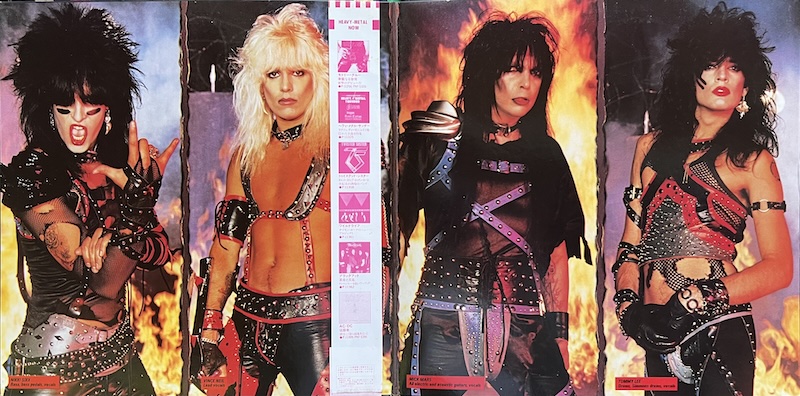
The entire record is filled with bangers. While I know Crüe blew into the stratosphere with their next three albums, their first two records are, to me, their best. Too Fast For Love is raw and unpolished, a mixture of gasoline and Jack Daniels being lit by a road flare, while Shout At The Devil takes a step in an even heavier direction and, of course, introduces the 80s satanism trope to give them even more an element of danger.1 I liked their output through the rest of the decade, but these are the albums I go back to time and time again.
Is the Japanese pressing worth it? Beauty is in the ears of the beholder. I think the Japanese pressings truly shine on music a bit more delicate than Mötley Crüe, but you can definitely tell the difference even when it’s metal. It’s not cheap per se, but not crazy either – the majority of the sales on Discogs are between $50-75, though if you want it with the obi strip you’re going to pay more, and higher quality copies can get up to about $150. I’m definitely a fan of Japanese pressings – I’m just judicious about when I choose to spend the extra. And in the case of Shout At The Devil, I’m going to say it was worth it.
- The “Satanic Panic” was a real thing in the 1980s. 13-year-old me was confident that bands like Crüe and Iron Maiden and Dio did not, in fact, worship satan. But man, when you’ve got most of the adults around you saying it’s true, as well as the national media… you could be forgiven for not being a bit nervous about it. ↩︎