
I first learned about Joshua Bonnetta’s The Pines project via an article in The Guardian. Just the basic concept is utterly fascinating – attach a microphone to a tree and have it record constantly for an entire year. Every sound. Every season. Everything. The idea is both utterly simple and completely preposterous. And I, for one, am glad to know that someone did this, and even more glad to know that he is putting a portion of this story into the world.
Getting a copy of The Pines proved to be no easy task, and I’m sure the The Guardian article contributed to this. I placed a pre-order with an American distro/shop and eventually received a refund and a note that they did not receive all their copies, so they could not fulfill all the orders and mine didn’t make the cut. I then ordered a copy from a seller on eBay, and simultaneously another I found on Amazon’s German site, and both of those fell through too. I was getting a bit desperate. Then one popped up on Discogs, offered by an Italian seller, so I pounced on that and immediately began cyber-stalking it as soon as I got a tracking number. And to my dismay… returned to sender! Turned out that was an issue with the labeling, which was quickly rectified, and a few weeks later my copy arrived, safe and sound. Fourth time is the charm, I guess.
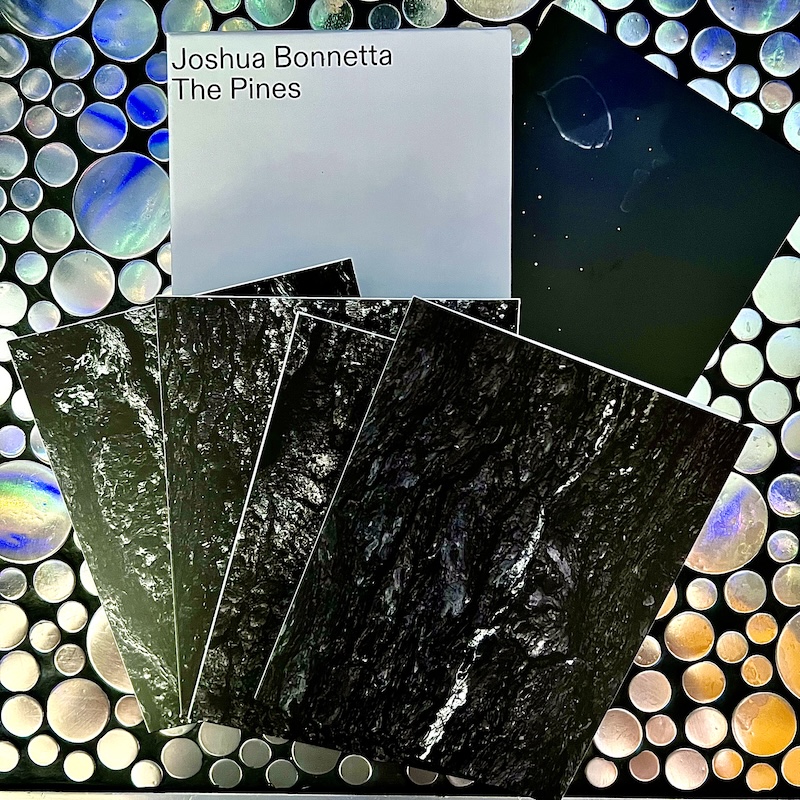
The Pines is packaged as a 4xCD box set, with a small 12-page booklet. Each CD runs almost exactly an hour and covers one of the four seasons. It begins with “Spring”, which is a logical choice considering how we think of the seasons, though it got me to thinking – would I actually prefer this if it started in winter and ran through fall? By beginning with spring, we end with winter, and while I do love the beauty of a snow-covered forest, the season lacks the hope of the others. The ultimate reason is perhaps more straight forward – Bonnette began the project in May of 2021, right in the middle of spring, so if we’re to follow this journey as it develops over time, that is the start.
Bonnetta made his recordings In Tioga County, New York, the microphone strapped to a pine tree. The tree itself was located on the land of the Onondaga Nation, which is fitting – I imagine they saw the value in such a project much more readily than a private landowner or the federal government. He returned to the tree every few weeks to change out the sound cards, eventually coming away with 8,760 hours of sound. Despite the analogue nature of the recordings, Bonnetta leveraged different types of technology to help identify certain types of sounds and to strip apart and re-combine sonic elements. The editing process took three years, in the time between other projects, a truly daunting task but one that came together magnificently.
“Spring” opens with a gentle rain… then an owl… creaking branches… flying geese… you quickly melt into the soundscape, barely noticing the transitions. I can almost smell the dampness as I listen to the heavier rain 14 minutes into the track (or should I say “season”?), the pattering of thick drops hitting leaves and branches, birds singing longingly from whatever shelter they have found. My dog’s head popped up from her afternoon nap a few times in response to… to what? An animal sound? The rain? Perhaps something even more subtle in the recording that my ears can’t pick up (for the record, she did not enjoy the thunder, and that was immediately apparent). And what is that scratching late in the recording? Is it one of the chipmunks Bonnetta said were obsessed with the recording equipment, scratching away at this unknown interloper in its environment?
I wonder what the tree would think of The Pines. It’s organized into four seasons, which is logical given how humans think about the flow of time over the course of a year. But the dates on which our seasons start are somewhat arbitrary. How would a tree perceive the changes in its environment? I suspect our concept of four linear seasons would not fit with its experiences at all. A tree might experience dozens of different “seasons” given its sensitivity to the world. Perhaps these seasons don’t even exist in a linear fashion – one could just as easily fast forward ahead multiple seasons during a warm spell in February, or even backwards during an unseasonably cold week in May. What signals let the tree know something is changing? Sure, there are obvious things like moisture levels and temperature. But does it too react to sounds? Or the sensations of animals or insects upon its bark? To a branch cracking under the weight of snow? The sensation of a pinecone growing… then eventually releasing its hold and falling to the ground? The tree would most likely be shocked by our rudimentary understanding of these things.
Crickets and insects greet us at the start of “Summer”. It feels like night. There’s probably a pond or a lake somewhere near by. But the owl is back, letting you know that the day-night cycle humans are used to doesn’t exist in the same way here, not for all the creatures at least. That is brought home even more forcefully with howling and barking – are those wolves or coyotes? There certainly seem to be more than a few of them… it can be dangerous to be out alone at night. Later a large buzzing insect pays us a visit, perhaps mistaking the microphone for some type of new flower, the sound conjuring up the image of a plump black-and-yellow bumblebee. There’s familiarity here, but it also reminds you how little of what you hear can you in fact definitively identify. Oh! Were those gunshots off in the distance? Or maybe fireworks? The sounds are too sharp and short to be thunder… is it July 4 I wonder? There’s even the occasional vehicle. Are we near a road, or someone’s property, or is someone off-roading? It sounds like they’re stuck in the mud close by now, the forest reminding man how insignificant he really is.
“Autumn” and “Winter” bring us their own sounds. The insects are less frequent, the animal noises less varied. Footfalls crush a layer of leaves carpeting the ground. I wonder if Bonnetta included any sounds he made on these recordings… his steps, his hand brushing snow away from a microphone, even his breathing. The wind picks up. Something hard hitting the tree… almost like a hatchet… what could it be? The sounds feel somehow slower in “Winter”, nature going into hibernation while the weather continues onward, relentlessly. Though there go the geese again, flying by, probably heading south in search of some warmth.
The Pines is a gift to the world, a reminder that we are but temporary custodians of the earth who have only walked its surface for the briefest amount of time. It’s also a warning, a warning that we have the power to fuck it all up royally, both by our actions and, just as importantly, our inactions. A hundred years ago, if the recording technology existed, one could have done a similar recording from quite literally where I’m sitting, on a sofa in my climate-controlled home in a neighborhood that was once a pine forest. A neighborhood in which many of nature’s ambient sounds today are overpowered by those of vehicles and people talking, of leaf blowers and pressure washers, of the hum of electricity flowing through the power lines that makes your fillings ache when you walk under them. The sounds of “society”. The sounds of “progress”. The sounds of a wounded earth ever-so-slowly trying to take back what we have stolen from it.
I’m not sure if there are avenues for streaming The Pines – only that it isn’t on Spotify as of this writing. However, you can listen to “Spring” in its entirety at Bonnetta’s Bandcamp page HERE, and you can also support him by purchasing a digital download of all four hours for just €15, which I’d encourage you to do – because we need more people in this world doing these kinds of projects.