
I remain utterly fascinated by Throbbing Gristle, to the point that if I run across one of their records out in the wild I’m quite likely to buy it. But I’m also fairly sure I’ve never played any of these records more than twice – I’d have to be in a pretty interesting headspace to think, you know what would be really great right now is some Throbbing Gristle. Their compositions (many tracks can’t truly be classified as “music” per se) are not danceable, nor are they fun, but instead something more akin to how Morpheus described Neo’s yearning to understand the matrix: “You don’t know what it is, but it’s there, like a splinter in your mind, driving you mad.” That’s the closest I can come to explaining Throbbing Gristle’s hold on me.
Last week I popped over to one of the Seattle-area’s newest shops, Volver Records on Mercer Island (or as we called the island it in the 80s, “Rich Rock”). It’s a small shop but well curated and full of very interesting things, though even so I was surprised to find these two TG records. And as usually happens when faced with TG vinyl, I bought them, shaking my head even as I tapped my credit card to pay.
The fact that a group like TG could manage to exist in 1970s England, or 1970s anywhere for that matter, outside of maybe West Berlin, remains mystifying. By all accounts basically no one got their art, whether that be the music, visual, or performance art, and they were faced with constant and aggressive resistance.

The earliest version of Nothing Short Of A Total War was released, I believe, in 1981. My version dates from 1987 and appears to include less tracks than the original. As is true with so many TG releases it’s difficult to tell precisely where these recordings originated. The jacket indicates they are unreleased recordings from 1977 to 1980, but I’m not sure that anyone really knows. And somehow that maddening mystery is part of the appeal. The A side feels like some kind of SETI experiment gone wrong, sounds generated and warped and beamed out into space (or are they being received from space…) on some kind long-wave signal, though probably with the intent of actually frightening away alien races. “Guys, this is what we’re about, so I don’t think you really want any of it. Move along.” The B side is more of the same, though with even more of a sci-fi feel in the electronics, sounding like a Star Trek phaser struggling with a dying power pack. There do appear to be some guitars here too, so distorted it’s hard to tell where the effect peddles leave off and the broader warping of the tape picks up. Instead of being underwater, this gives the sensation of being undermolasses, trapped in a sticky, opaque brownness as disembodied sounds arrive in your ears via bubbles. FWIW my copy came with two Cosey Fanni Tutti flyers entitled “Time To Tell”. I’m not sure if these came with this release – they don’t show on the Discogs listing, and there’s just no way for me to be sure.
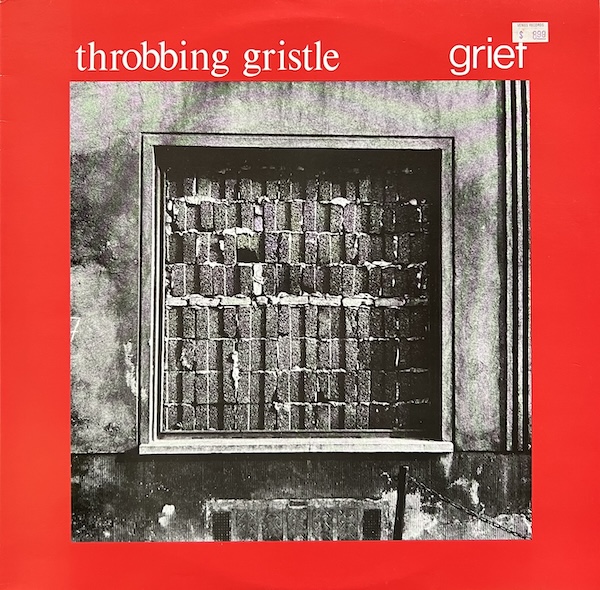
Grief “feels” a bit more like TG to me. The A side, “Camera”, is a sonic collage combining strange electronics and heavily reverbbed vocals – I can’t tell if they are from a recording or if they were being performed live. I suspect they are live, or a recording of an interview done with Genesis P-Orridge. Eventually, however, those vocals give way to something more… tortured. More base. More uncomfortable. Then on again to something non-English. It’s like being stuck in a dream, in a room full of doors, and behind each is something… other. And none of it intended to make you feel good. Or safe. Or rational. Or sane. The B side track “Telephone” is actually fairly similar in approach – it would be easy to think of these as one continuous composition.
As if I needed to provide any more evidence of my ongoing enthrallment with TG, I just ordered Genesis’ autobiography Nonbinary: A Memoir. I know P-Orridge is an unreliable narrator, but I’m still curious to learn more about how they perceived themselves.