
1.44mb is an independent speciality label in Philadelphia I came across while researching Adam Buffington’s latest CD The Winter Loving Idiot, because, well, Adam is one of the two guys behind it. I was intrigued by 1.44mb for two reasons. The first and most obvious was the type of recordings they put out which can most simply be described as “experimental” but often veer into avant-garde and musique concréte and the just plain weird. For example, Andy Heck Boyd’s Jupiter which is, well, I’ll let the description on Bandcamp speak for itself: i play a plastic drinking straw and cover symphony no. 41 in c major, k 551 by wolfgang amadeus mozart. Yes, you are reading that correctly. A Mozart symphony played on a plastic drinking straw. And yes, it is compelling.
The second reason is that 1.44mb puts out its physical releases on 1.44mb disks.
Now, I’m old enough to remember 5.25″ disks, the true “floppy” disks that were, in fact, floppy and bendable. The idea that a game or a program in fact lived on these disks and not on your hard drive (or the internet, which was only vaguely a thing then) seems strange today, but that was the reality, and sometimes it took a stack of disks to get something loaded up to use. These floppies were later supplanted by the smaller, higher capacity, and sturdier 3.5″ disks, which at 1.44mb of storage were fine for files but not so great for other things, like pictures and music. Ridiculous story – my first digital camera (Sony Mavica) actually stored photos on a 3.5″ disk that you inserted into the camera – I seem to think it could hold maybe 10 or so pictures per disk, and you literally had to wait for it to write to the disk before you could take another photo. Bonkers.
3.5″ disks haven’t been manufactured since 2011, so it’s reasonable to ask why anyone would put out new releases on a dead format. So I posed that question (and others) to the gentlemen behind 1.44mb, Alex Dragonetti and Adam Buffington.
In your Substack, (compressed), you talk about the why behind using the 3.5” computer disk as the physical medium for 1.44mb releases, citing the limitations it imposes along with the physicality and nostalgia elements as well. Why do you think we (and I definitely include myself here) are drawn toward the idea of owning a physical copy of music, especially in the era when an overwhelming amount of music is instantly available at the click of a few buttons? When downloads were still a new thing in the 90s it seemed like the idea of “owning” files was just an expansion of physical media, and people were downloading hundreds and hundreds of files they never even listened to. But today the idea of “owning” music seems non-sensical to many people.
Adam: “I have always been fascinated with collecting physical media. Whether books, vinyl, cassettes or CDs, I am interested in the physical properties of the object – the texture, the space it occupies, and even the smell of old paper and cardboard! For me, all of these characteristics contribute to a deeper bond with an object, and add to its history: where was this made? Who owned this object before me? What was their relationship to it?”
Alex: “What appeals to me as a consumer of physical media is exactly that it represents ownership, as well individual support of the artist. The support thing is more than monetary – my friends’ cassettes, CD’s, etc, at my desk are a reminder of them and their creative ventures, and keeping that thought in my mind feels like a pretty high level of support to me. Regarding ownership, at this point, if you use a streaming service like Spotify to listen to music, you don’t even own the files. If the streaming service chooses to drop your favorite album, they can, on a whim, and it’s gone. That, avoiding ads, and being a bit of a luddite are why I never stopped using a dedicated mp3 player separate from my phone. In my heart of hearts, I’m just one of those silhouette people dancing to ‘Are You Gonna Be My Girl’ from the old iPod commercials.”
Much of the music put out by 1.44mb falls into the broader “experimental” category, regardless of whether we think of it more formally as Fluxus or avant-garde or musique concréte, etc. In my experience many, if not most, people will dismiss experimental music out of hand. But for some it is… compelling in a way that’s hard to explain and even fully understand. As both performers and fans of this kind of sound, why does it appeal to you personally?
Adam: “For me, experimental music is an incredibly broad category, and in many ways, consists of a vast web of what now could be considered musical ‘traditions’ or ‘canons’ in their own right. Like any other category of music, there are records or musicians that interest me more than others, and that changes over time. I often cannot explain what is exactly happening within some of the music I listen to, and that’s the appeal to me: the unknown, the mystery, and the various facets of experience that it confronts, engages with.”
Alex: “The appeal to me is challenging how we experience and engage with music. I don’t think of experimental music scratching the same itch as other genres of music, but instead closer to engaging with art. Adam’s turned me on to a lot of stuff that made me recognize music’s potential for saying ‘the boundaries don’t have to be here.’ I’ll always have a soft spot for art that meets the consumer more than halfway on that sort of point, like Cage’s Water Walk (thanks to Adam for introducing that one to me), so you can expect we’ll host plenty of that.”
It’s never been easier to start a micro label thanks to platforms like Bandcamp and the ability to reach potential audiences via social media. But with that comes a ton of competition. What do you see as the future evolution of small, niche labels and/or individuals trying to put their music out into the world? Does it potentially look different for more experimental and avant garde performers than it does for those operating in more mainstream-adjacent genres?
Adam: “The method of self-releasing or creating small, niche labels has always been the modus operandi for any sort of underground music and art, and I don’t forsee that changing. Especially earlier on, I think online platforms like Bandcamp had a tremendous impact on how musicians could disseminate their music (physically and digitally) and connect with both new listeners and discover kindred spirits and ‘scenes’ that they might not have been able to otherwise. And though I think that is still a possibility, this sort of music will always be on the periphery, and will always be primarily created and circulated by the musicians themselves and a select few admirers.”
Alex: “I’m back and forth on cynical and hopeful. I think there’s still a way to piecemeal a career out of being a musician if you’re willing and able to play event music and teach private lessons, and the quality of affordable tools for music making available to the general public is mind-boggling. I just think the ‘artist’ path is becoming needlessly harder because of changes in policy related to social safety nets (at least in the US, where I’m based). I’m also back and forth on the internet as a conduit for getting music in front of listeners. I’m hoping that I, and others like me, on the ‘fringe’ (a little out there but with mainstream sensibilities) stand to benefit from our current paradigm.”
OK, now it’s time for the really hard-hitting journalism. Adam, you’ve been living andteaching in Iceland recently, a country near and dear to my heart having attended Iceland Airwaves more times than I can count. Where are your favorite places in Reykjavik for pizza and coffee, the two essentials in life? For full transparency, Reykjavik Pizzeria up near Hallgrimskirkja is a must-visit for us every trip, and Reykjavik Roasters is our coffee go-to… though Café Babalú is definitely the spot if you want a chai. Alex, you’re free to weight in here as well about Reykjavik or the city of your choice.
Adam: “I have been coming back and forth to Reykjavik since 2016. The city has honestly changed quite a bit within the past decade! I don’t have pizza too often here, but I have a few favorite coffee spots where I work and meet friends: Mokka Kaffi is the classic, and I often meet friends at Plantan Kaffihús or Kaktus Espressobar. Systrasamlagið is another calm place as well.”
Alex: “I have never been to Iceland and hardly leave the Philadelphia area, BUT, I feel good about saying that Philadelphia’s Pilgrim Roasters is the best cup of coffee you can get in the city and that there is no good reason to ever be more than an hour away from Philadelphia at any time.”
What’s up next for the 1.44mb label, and for each of you individually?
Adam: “I am relocating back to the States this summer, so I will be lying low and planning my next move.”
Alex: “1.44mb’s next release is going to be Local Net, a short piece by 160m band, an artist whose ‘instruments’ are all radio equipment, samples are collected by radio, and pieces often explore human connection and isolation. I want the label to start pushing boundaries on physical releases after this year. We understand how to do floppy disks, one of our next projects is,
‘what other medium can I put audio on (possibly that would be a good tool for artists, the way floppy disks were for me)?’
“For me, personally, I’m going to focus more on playing and recording with my band, LFA. The band does covers of rock/pop tunes but with jazz sensibilities, as well as record original music. LFA has a split floppy disk for the label coming this Summer.”
I picked up some 1.44mb releases, and just having them in my hands makes me happy.
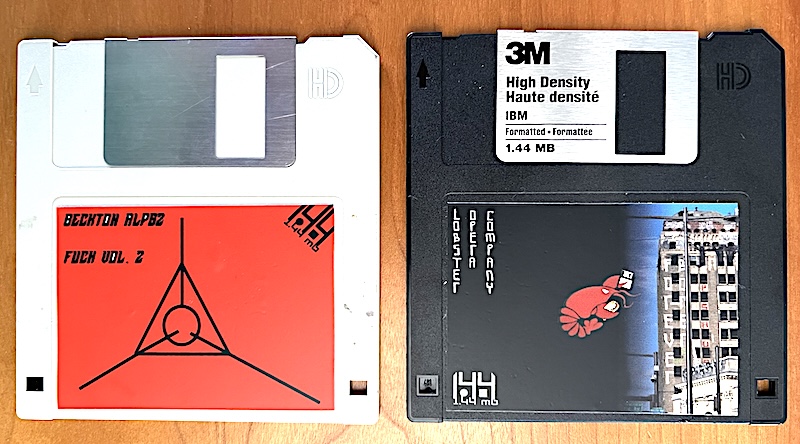
Full disclosure – I no longer own a computer capable of using a 3.5″ disk so… I didn’t listen to the actual physical media. Instead I listened to the compressed versions on the label’s Bandcamp page. Note that if you buy the physical media you also get downloads – both of the compressed and the non-compressed files. So sure, I could listen to the original files, but what fun is that? Part of the experiment is compressing compositions so they can fit on the limitations imposed by the medium, so let’s stay true to that.
Beckton Alps2’s Fuck Vol. 2 is beat-driven, but that’s about as close as it comes to techno. In the first track the beats and pulses bounce from channel to channel, from ear to ear, pulsing, bleeping, blooping, marching inexorably forward, toward what you can’t be sure. By the last minute the sound drops away and slows, lulling you into a false sense of security before you’re BLASTED with a modulated voice and siren-line wails. The second tracks takes a similar approach with the sounds more muted, giving you the sense of some kind of buffer, as if it’s being played in the next room over. Is it actually the same track, just more compressed? It might be, and it’s languid nature is definitely appealing.
Lobster Opera Company’s Broad & Erie is even stranger. “Move On” is primarily structured around a pair of repeated vocal samples – one of a preacher, another of what sounds like a 1970s TV commercial urging us to “move on in”. All the tracks are based on samples of various length described as “a slice of a slice of life in god’s favorite city, the Lobster Opera Company pays homage to the Philadelphia region’s quirks and idiosyncrasies”. And as someone who has roots in that city, I’m here for it. It definitely feels like a trip in the wayback machine.
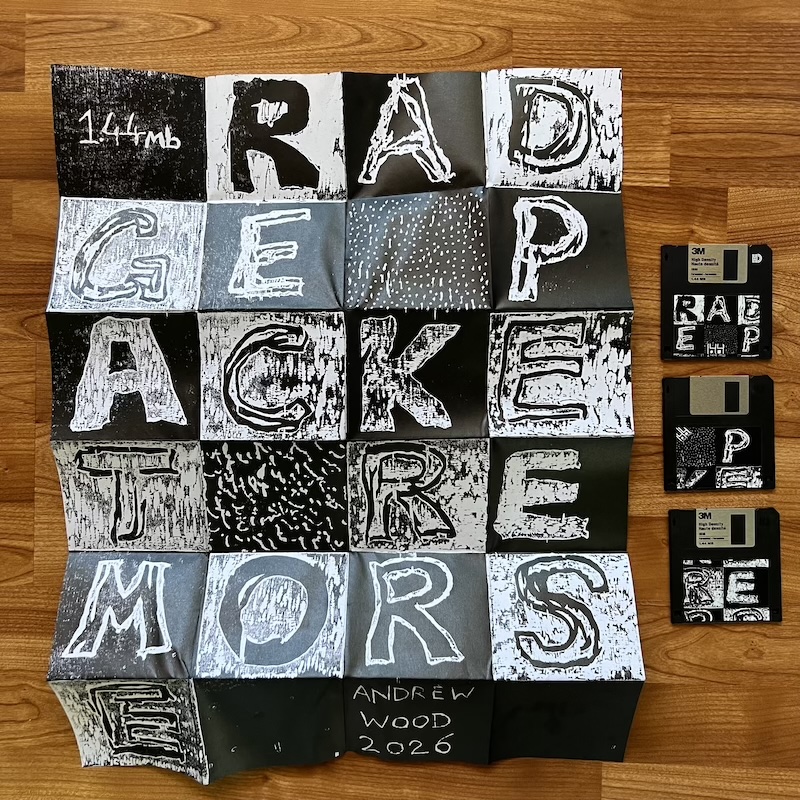
Perhaps the most ambitious project (OK, aside from the previously mentioned Jupiter…) is Andrew Wood’s RadgePacketRemorse. Spread across three disks it’s a full album with nine tracks and coming in at 24 minutes, the disks enclosed in a numbered 18″ by 24″ poster. Field recordings, oscillations, the found and the lost all come together in an expression of fragility. It’s not hauntology per se, instead… what it feels like to me is looking though a album of old photos with no context. They were probably taken in the 1960s or 70s and originally in color, but after 50+ years the colors are muted and a blurred, the printing deconstructing itself and making most of the images look like they were taken through the thinnest layer of gauze. You don’t know these people, or anything about them. You just have a sort of story that snaps forward in time by months or even years with no context – a day at the beach here, an office building, a child’s birthday, a woman standing next to a taxi, a man with a cigarette hanging from his mouth… It’s the banality of existence, a past totally different from the present, yet in many ways completely the same.
RadgePacket Remorse is, in fact, one of my favorite albums of 2026 so far. Will it find its way onto my annual year-end Top 5 list? it’s too early to tell, but it’s holding down a spot right now.
There are some other gems on 1.44mb as well. Alex’s own Floppy and Floppy II are more straight-forward, lo-fi electronic albums, and I dig GODTRAWLER’s eponymous release, a dark trip through spacey distortion that hits like a cyber-steam-punk punch to the head.
You owe it to yourself to explore the 1.44mb catalog on their Bandcamp page HERE. I for one will be following them with interest to see what they come out with next (and next, and next…).