
If the title of this blog looks like some kind of secret code, well, I agree with you. In fact part of it (DG 307) is a kind of code. A diagnostic one. And given that the story of (1973-5) takes place during the Cold War and involves censorship, secret police, and imprisonment, well…
Our story begins in a country that no longer exists – Czechoslovakia. A coup d’état three years after the end of World War II firmly established Communist control over the nation and it became a de facto satellite state of the Soviet Union. The people of Czechoslovakia, however, weren’t exactly thrilled with this turn of events and things came to a head in 1968 in what became known as the Prague Spring, an eight-month period of reforms and mass protests (including the self-immolation of Jan Palach and others) that were eventually crushed by the combined military forces of Warsaw Pact nations. What followed was a period of re-establishing Communist power structures called Normalization, which included new censorship laws.
Intellectuals and artists continued to resist the impositions of the powers that be. One such man was poet and musician Pavel Zajíček, who in 1973 partnered with bassist Milan Hlavsa (also well-known in his homeland for being part of The Plastic People of the Universe) to form a musical group called DG 307. The name of the group itself was overtly protest-coded. At the time military service was compulsory for young Czechoslovakian men unless they were able to obtain a “blue booklet” which exempted them. There were a number of ways to obtain a blue booklet, many of which were related to various physical disabilities. But a man could also be designated DG 307, which indicated he was psychologically unfit for military service. Contemporary sources don’t provide a lot of specifics as to what precisely could lead to a classification of DG 307 – it was said to be used as a catch-all to label “undesirables”. However, there is a bit of a clue as to the meaning, or at least where it originated.
When I was in college majoring in psychology way back in the 1990s the gold standard for psychological diagnoses was a book known as the DSM-III-R, which like the title of this blog sounds like some kind of secret code. It’s full name is the Diagnostic and Statistical Manual of Mental Disorders, Third Edition, Revised, which is a mouthful. If you wanted to establish a person had a defined, diagnosable mental condition, you had to be able to show how they met the criteria established in this book, and it was widely used. As you can guess by the Third Edition, Revised part of the title, there were also earlier versions. For example, the DSM-II was published in 1968. And wouldn’t you know it, the DSM-II had a diagnostic code 307, sometimes referred to as a diagnostic group (DG…). Specifically 307 was used for “Transient Situational Disturbances”. More specifically:
This major category is reserved for more or less transient disorders of any severity (including those of psychotic proportions) that occur in individuals without any apparent underlying mental disorders and that represent an acute reaction to overwhelming environmental stress.
Which sounds… sufficiently vague to be used for any person experiencing some kind of undefined “transient disorders” and certainly seems to fit the overall DG 307 designation. Basically it says you don’t fit into society and probably won’t fit into the military either.
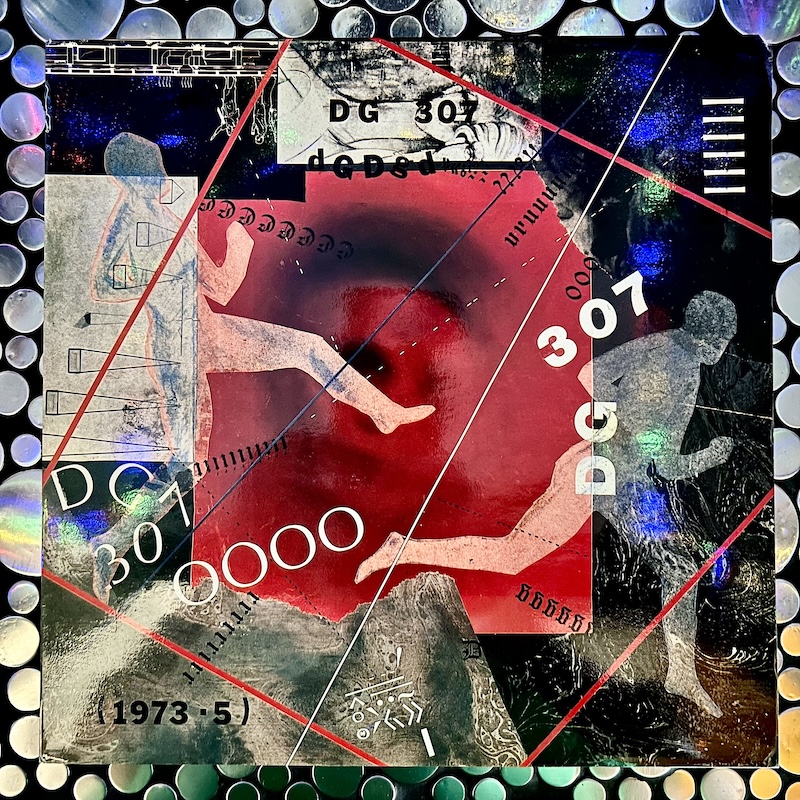
DG 307 performed during the mid-1970s but had no means by which to release music given the state control of media.1 The authorities continued to disrupt their efforts, culminating in Zajíček’s arrest in 1976 and eventual exile to Sweden in 1980, where he did manage to release an album of the band’s music in 1982 called Gift To The Shadows (Fragment). The group re-formed after the fall of the Czechoslovakian Communist Party in 1990, which opened the door for them to perform and put out music in their home country. Their first release on a Czechoslovakian label was in 1991, a collection of their earlier recordings called (1973-5).
Whew, that was a lot to get us to this record. I picked it up a few weeks ago at Volver Records after they returned from a recent cross-country buying trip. This kind of thing is very much in my wheelhouse. Not only is the story behind it deeply fascinating, it’s also inspiring. Imagine being an artist living in a police state and persecuted for your art, but still doing it anyway at great risk to your personal safety. How many of us would have the courage to do that? Probably not most of us, myself included.
DG 307’s earlier material is also notable for what it is, which is highly experimental and bordering on industrial before that was even a term. The recordings are, understandably, raw, but it’s the sonic elements that sent it apart. Feedback-drenched guitar, metallic percussion, a metronomic bass, and anguished, shouted vocals. If you’re a fan of early Throbbing Gristle you’re going to enjoy (1973-5). It lacks the electronic component of their English counterparts, but the spirit and intensity is the same. At least some of it was recorded live, as we hear the small audience at the end of some tracks.
DG 307 continued to put out music into the 2000s and some of their 1970s live recordings have since surfaced and been given formal release – there’s a lot of material out there. I’m definitely going to be trying to track down some additional recordings. Amazingly you can find a number of DG 307 titles on Spotify, so if you’re looking for something weird, give ’em a listen.
- There was an album, which appears to be a homemade cassette with printed j-card and inserts, released in Italy in 1979. Also, there are recordings from the mid-to-late 1970s which have been released over the years, primarily on the Czech label Guerilla Records. I wasn’t able to fully untangle what kinds of material exists due to a combination of the language barrier (most reliable sources are Czech) and the very underground nature of these early recordings. ↩︎