
“Jeff! Don’t put that record back!”
Admittedly I was startled when John over at Volver Records shouted this to me (he had to shout not due to the distance between us, but more out of sheer excitement). I’d only picked it up to look at it because the Roy Lichtenstein-esque cover caught my eye. “It’s right up your alley,” he said, “early 80s French new wave, but with a sort of Tangerine Dream thing going on.” And that description is how John makes me feel seen in the shop. Clearly he’s been mentally noting what I buy, and while I might not see the patterns myself, they’re all too clear to his trained eye. And that’s how a 1980 pressing of Play Back found it’s way into my pile. After all, you can’t take the money with you.
I didn’t really know anything about Space Art when I sat down to start this post. Then I thought to myself, “hey, this is the perfect opportunity to get some use out of Colin Larkin’s The Encyclopedia of Popular Music, Fourth Edition that you bought off eBay on a lark a while back”. Considering how much space the 10 volume (!!) set takes up on my shelves (space that could be used to hold more records…), it would be good to crack it open and see what it has to say about Space Art. And… no entry for Space Art. C’mon, Colin!
Anyway… I also have the internet, and this morning I learned that Space Art were the duo of Dominique “Terracota” Perrier on keyboards and Roger “Bunny” Rizzitelli on drums. They combined for three albums under the Space Art name between 1977 and 1980. Play Back was the last of these, and also seems to be the most polarizing. Most reviewers agree it isn’t as strong as Space Art and Trip In The Center Head, but the jury is out on it’s stand-alone quality. So let’s give it a spin and see.
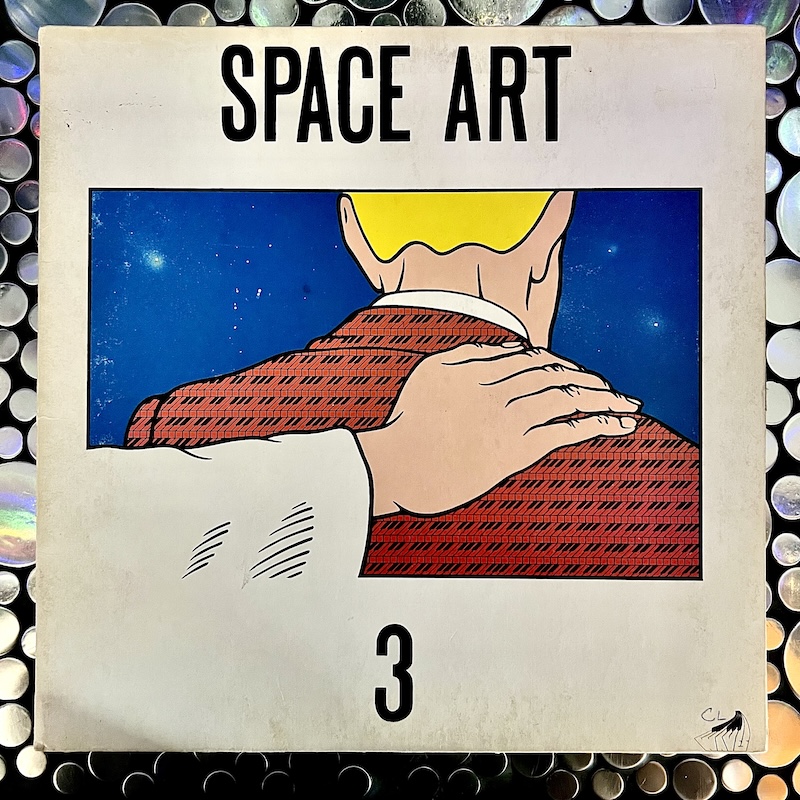
It’s hard for early synthesizer work to not sound, well, dated. There are rock albums from 1980 that still sound, at least to my ears, like the could be from a much more recent era – Back In Black, Ace Of Spades, Fresh Fruit For Rotting Vegetables, etc. But man, those synths make it impossible to hear an album like Play Back as being from any other time. Sure, you can probably find a newer album or two being made with vintage equipment that sound superficially a bit like Play Back, but I’m not sure anyone today can re-create the feel of the era, the vision of the present and how it will become the future, the sterility of technology, the iciness of feeling.
“Paris Vision” leverages an effect that very much reminds me of the vocals on Peter Frampton’s “Do You Feel Like We Do” (recorded five years prior), but instead of the effects being run through the microphone it feels like possibly some vocal samples being played via the keyboard. This continues on the B side with “Love Machine”, but here the vocal piece is more pronounced and very Kraftwerk-ian, though with drumming that still feels quite organic and analog, anchoring it into the present moment. The more I listen to Play Back, the more I come to appreciate Rizzitelli’s drumming. It’s not percussion simply for the sake of a beat and timing, but instead breathes life into the songs and takes on a jazzy quality that injects just a bit of it’s emotion into the synths.
Play Back falls into a bit of a musical crevice in my mind, somewhere between prog rock on one side and the 1970s electronic pioneers on the other. But it doesn’t get totally lost there – if you can’t hear the influences of tracks like “Welcome To Love” on contemporary artists like Daft Punk, then you’re not even paying attention.
Following Rizzitelli’s death in 2010, Perrier partnered with other artists on a tribute album for his late friend and released Space Art Tribute in 2012. He then partnered with Rizzitelli’s son Tommy to put out two more Space Art albums before Perrier himself passed away in 2023.