
There is a strong DIY ethic in the dungeon synth (DS) community. Given that basically no one has achieved anything even remotely resembling mainstream success with their DS projects, this is in part a necessity. There are a number of specialty labels, but perhaps only one or two big enough to constitute being someone’s full-time business, and even then it’s probably only big enough to support a single person. A lot of physical media is produced, a significant portion of it on cassette.1 Including various “extras” as part of the release is also a well-established practice – small charms, stickers, pouches to hold the cassette, all kinds of things that make it a bit more personal and, frankly, fun.
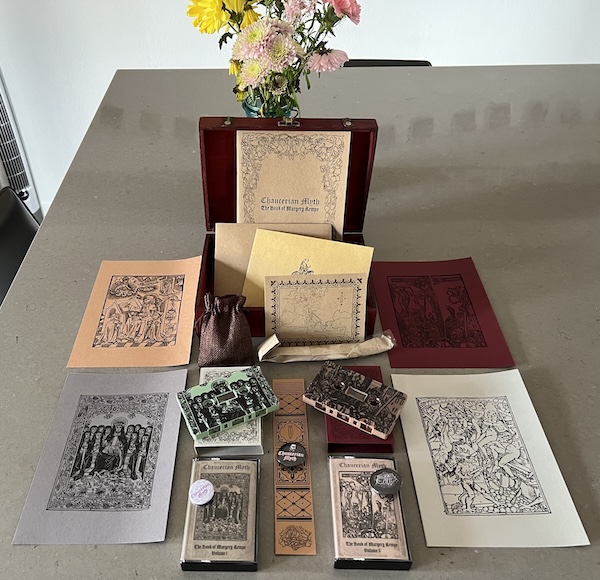
There are also more ambitious, limited releases. One example is this fantastic box set re-release of Chaucerian Myth’s 2017 double-album The Book Of Margery Kempe. Originally put out in a 2xCD format with a slipcase, booklet, and button (or badge as my friends in the UK would say), last year it got two different treatments from label Fogged Entity. The first was a simple double cassette limited to 30 copies. The other was, well, a masterpiece, a boxset produced in an edition of 15. And this isn’t your typical box set. No. It comes in a wood box with metal decorative details. Inside it’s chock full of surprises – art cards, a booklet, buttons, stickers, a candle, and even a small pouch of white sage. The attention to detail and to the telling of Margery Kempe’s story is found throughout – it’s truly exceptional. I was very bummed when I missed out on a copy upon release – it sold out immediately. But as luck would have it months later I just happened to be on Facebook at precisely the right time and saw Fogged Entity post they had a copy available to the first person to reach out, and I jumped on it. Every now and again that nasty phone habit pays dividends.
I happened to be familiar with the story of Margery Kempe (and her book) thanks to the 2022 book Re-Sisters by Cosey Fanni Tutti, the artist and former member of Throbbing Gristle. Tutti provides us biographies of three “outsider” women and the challenges they faced in a male-dominated world – 1400s mystic Margery Kempe, electronic musician and composer Delia Derbyshire, and herself. I can’t recommend this book enough, but if you just want a bit of context you can read about Kempe on Wikipedia HERE. While you’re there, go learn more about Derbyshire too, because she’s every bit as fascinating (as, of course, is Cosey Fanni Tutti herself).
The Book of Margery Kempe diverges from other Chaucerian Myth albums, at least in the early tracks which have a more modern, but also a highly experimental, feel about them. This is almost certainly intentional, as the first songs “Deep Sickness” and “Demonic Visions” are about Kempe’s early life and experiences with what we would today assume to be mental illness but at the time was alternately viewed as either demonic possession or divine inspiration. It was a troubled time in her life, one defined by public outbursts and accusations of heresy, and Chaucerian Myth’s sonic approach captures the turbulence of a troubled mind. By “Birth of the Virgin” we’re heading back to a more typical Chaucerian Myth sound, a lilting journey up and down the scales, dulcimer and chimes and xylophone conducting a pretty dance. By “Julian Of Norwich” we’re fully back into what makes Chaucerian Myth so amazing, his ability to capture what we envision music of this period probably sounded like. Things take a darker turn by time we reach “Jerusalem” which is… intense, ending in a repetitive migraine-like dirge. We’re brought back home with the closing song, the 30-minute “Meditations: The Visions of Margery Kempe”, a lovely meandering and relaxing walk.
Fortunately you don’t have to stalk Discogs and eBay to track down a physical copy in order to give The Book of Margery Kempe a listen. You can just pop on over to the Chaucerian Myth Bandcamp page HERE and get yourself a digital copy or give it a play on Spotify.